
Frequently asked questions
If yours is not here, the admissions office would rather you called than guessed.
How the school is organized
How does the cluster system work?
Students are grouped in multi-age classrooms that typically span two grade levels. Those classrooms are organized into clusters: Youngers is three K-1 classrooms, Bridge is one second grade classroom, Middles is two classrooms of third and fourth graders, and Olders is three classrooms of fifth and sixth graders.
The cluster system builds community across classrooms and gives students a group to learn and play with. Every year we consider each student's placement carefully, gathering input from teachers and students and weighing academic progress, social-emotional development, leadership opportunities, and relationships with peers and teachers.
What are the benefits of multi-age grouping?
Younger students gain access to advanced models of thinking and problem-solving, while older students deepen mastery by teaching, mentoring, and leading. Teachers differentiate so students are challenged based on readiness, not simply age.
Because teachers work with students over multiple years, they identify strengths, gaps, and opportunities for extension more effectively. Over time, every child experiences both roles.
What is a typical day like in Youngers?
K-1 students begin with a Morning Meeting, a routine that helps them settle in, build community, and preview the day. From there the day balances whole-group activities, small-group instruction, one-to-one time with teachers, and independent work.
Reading, writing, and math are taught in developmentally appropriate ways. Science and social studies come through hands-on inquiry. Play is essential, with outdoor time, free choice, and creative exploration, plus weekly time with the specialists.
The K-6 arc
Why is a K-6 experience important?
Children change dramatically between five and twelve, not just physically but in how they learn, connect, and see the world. A K-6 model honors that evolution and keeps students in an environment that understands the whole child at every stage.
We view sixth grade as a natural point of reflection. By then students have confidence, a strong sense of identity, and the readiness to help choose their next school. Rather than locking families into a long path too early, we encourage intentional decisions one step at a time.
What is the transition to middle school like?
PS1 students go on to a wide range of middle schools, from the most progressive to the most traditional, because they leave with a deep understanding of who they are as learners.
Known for academic strength, curiosity, and social ease, PS1 graduates are often sought after in the middle school admissions process. Many alumni credit their success to the foundation they built here.
Why pluralism?
From the first day of kindergarten, we help students understand themselves as individuals and as members of larger communities. The curriculum, the schedule, and even the campus are designed to inspire both cooperation and individual reflection.
As students expand their comfort zones, from small-group projects to their classroom, school, neighborhood, and the wider world, each learns how and why to make positive change at every level.
Day to day
Does PS1 offer a world language program?
Yes. All students in grades K through 6 take Spanish, which builds language skills, cultural understanding, and global awareness. It is one of six specialist subjects alongside art, music, PE, library, and The Studio.
How does PS1 use technology in the classroom?
Technology is one of many tools, used purposefully to deepen understanding and support skill development. Students build keyboarding, word processing, and research skills, and create multimedia presentations using iPads and computers.
In The Studio, technology is central to design and engineering projects. Students model ideas in software and bring them to life with tools like the 3D printer.
What is the homework policy?
Homework is purposeful and developmentally appropriate, and increases incrementally from kindergarten to sixth grade. Assignments reinforce classroom learning and may include ongoing projects that build time management ahead of middle school. We keep it meaningful and manageable.
Why does PS1 not give grades?
We believe learning should be driven by curiosity and intrinsic motivation, not the pursuit of a letter. When students are engaged in meaningful work, they naturally strive to do their best, and research shows traditional grades can reduce interest in learning and limit deeper thinking.
Instead we use narrative report cards, rubrics, and twice-yearly parent-teacher conferences, with close communication throughout the year.
Joining, safety, and logistics
How are incoming students and families welcomed?
Every incoming family is paired with a host family. In the spring, newly enrolled families come to a New Family Dinner. Through the summer there are playdates on and off campus.
Just before school begins, new K-1 students get a home visit from one of their teachers, and all new students are invited to Make New Friends Day to explore classrooms and practice the routine. The first day brings a welcoming coffee and a New Parent Orientation, and the first week is half-days.
How does PS1 handle campus safety and security?
A Security Officer on staff monitors campus activity, supports dismissal, and works closely with school leadership. We run safety and security audits with outside experts and use the results to update procedures, policies, and systems.
Staff are trained in emergency response by the Santa Monica Police Department, and we maintain a relationship with our designated School Resource Officer. We have an internal emergency response team, a crisis management plan, monthly safety drills, and a text-alert system for parents.
Does PS1 have sports teams?
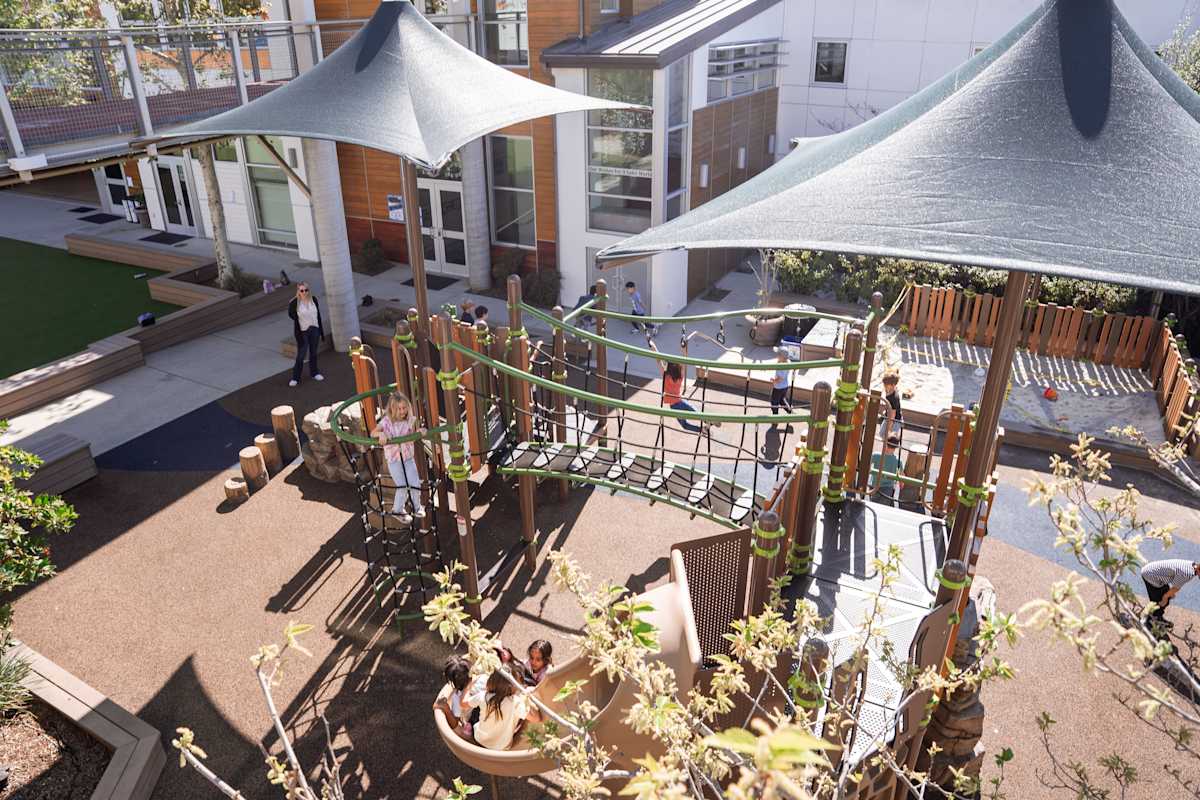
No. PS1 is a non-competitive school. Physical activity is still central: students have PE up to three times a week, playgrounds are lively at recess, and many students join community-based teams after school.
Does PS1 offer transportation?
No. Optional transportation ran during the 2023-24 school year but was not continued.